The Problem with Intuition: Why Traditional Assessment Fails
In the highly competitive real estate investment market, the key to success lies in finding and accurately assessing properties with genuine high-profit potential. Yet traditional assessment methods remain stubbornly inefficient and risky.
Most real estate investors today still rely on experience and intuition. A seasoned flipper might “feel” that a property is a good deal based on years of pattern recognition. But “feeling” introduces several critical problems:
Cognitive Biases: Experienced investors are prone to anchoring bias (overweighting initial impressions) and confirmation bias (seeking data that confirms preexisting beliefs). A flipper who has successfully renovated similar properties in the past may overestimate their ability to execute on a new property in an unfamiliar neighborhood.
Missing Information: Even experienced investors have limited vision. They might know their own market intimately but miss emerging trends in adjacent neighborhoods. They may not track current construction cost inflation, local employment changes, or subtle shifts in buyer preferences.
Inconsistency: Two experienced flippers evaluating the same property might reach dramatically different conclusions. There’s no standardized methodology—just intuition applied inconsistently.
Opportunity Cost: Valuable time spent analyzing properties manually is time not spent on renovation management or deal execution. Investors waste 30–35 hours per week analyzing 60–75 properties to identify just 2 viable deals.
The result: missed opportunities, poor capital allocation, and higher failure rates.
The Solution: Standardizing Assessment Through Machine Learning
FlipSpring’s core value proposition is simple yet powerful: standardize and quantify the complex property evaluation process through machine learning, culminating in our proprietary Flipscore.
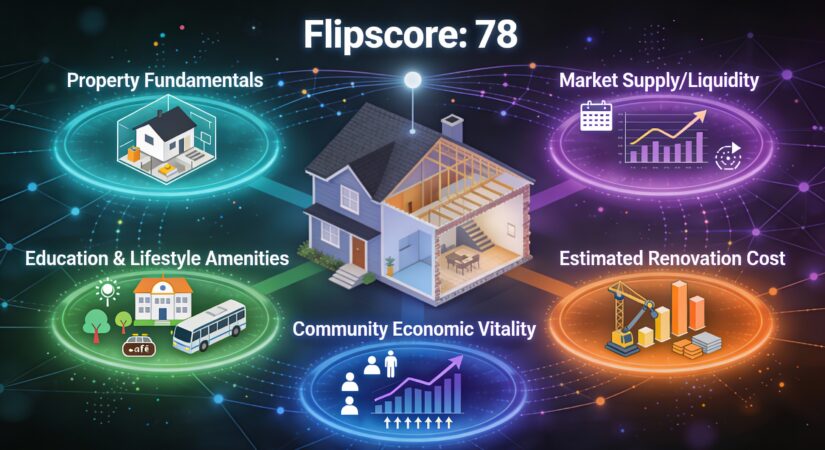
The Flipscore is not a magic number. It’s a scientifically rigorous, multi-dimensional data model that synthesizes six core assessment dimensions into a single actionable metric on a scale of 1–100.
The Six Dimensions of Flipscore
1. Property Fundamentals & Condition
This dimension evaluates the property’s physical state—the foundation for all flipping decisions.
What we analyze:
- Structural integrity (foundation, framing, load-bearing walls)
- Building systems condition (roof age and condition, HVAC functionality, electrical panel capacity, plumbing serviceability)
- Interior condition (flooring, walls, ceilings, kitchen/bathroom fixtures)
- Layout efficiency (is the current layout suitable for target buyer profile?)
- Age and obsolescence (how old are major systems? What’s the remaining useful life?)
Why it matters: A property that appears “move-in ready” at first glance might conceal $20,000–$40,000 in hidden structural or mechanical issues. Conversely, a structurally sound property with cosmetic issues represents genuine opportunity.
Our assessment goes beyond the surface-level inspection. We integrate computer vision analysis of photos and satellite imagery to evaluate roof condition, curb appeal, and landscaping automatically—capturing details that human inspectors might miss.
2. Market Supply & Liquidity
This dimension analyzes the local real estate market’s health and resale feasibility.
What we analyze:
- Housing inventory levels (how many similar properties are currently for sale?)
- Average days on market (how long does it take to sell a property in this area?)
- Transaction activity (how many sales occurred in the past 90 days? Is the market active?)
- Turnover rates (how frequently do properties change hands?)
- Market velocity (is the market accelerating or decelerating?)
Why it matters: A property in a high-inventory market (90+ days on market) represents higher carry costs and resale risk. A property in a liquid market (20–30 days on market) with strong transaction volume represents confidence that your renovation and exit timeline are achievable.
Real estate is fundamentally local. A property that flips easily in a hot market might languish unsold in a soft market. Flipscore captures this critical context.
3. Community Economic Vitality
This dimension evaluates the neighborhood’s long-term appreciation potential through macroeconomic indicators.
What we analyze:
- Median household income (what’s the wealth profile of your target buyer?)
- Population growth rate (is the neighborhood growing or declining?)
- Employment growth trends (are local employers hiring or contracting?)
- Business concentration and diversity (is the local economy diversified or dependent on one industry?)
- Educational attainment (higher education correlates with stable, appreciating communities)
- Crime rates and safety (does the neighborhood feel safe to prospective buyers?)
Why it matters: The best-renovated property won’t appreciate if the neighborhood is declining. Conversely, a mediocre property in a rapidly revitalizing neighborhood (like Toronto’s Weston or Humewood/Cedarvale in 2025) will appreciate driven by neighborhood tailwinds, not just renovation quality.
Flipscore captures neighborhood trajectory—not just current conditions, but directional momentum. Is this neighborhood gentrifying? Is employment growing? Are new amenities being developed?
4. Education & Lifestyle Amenities
This dimension evaluates factors that directly influence buyer willingness to purchase and property value premium.
What we analyze:
- School quality (proximity to top-rated schools, school catchment area)
- Parks and recreation (walkability to green spaces, parks)
- Transportation accessibility (proximity to transit, commute times to employment centers)
- Commercial amenities (grocery stores, restaurants, retail, gyms)
- Cultural amenities (museums, theaters, arts venues)
- Walkability score (how pedestrian-friendly is the neighborhood?)
Why it matters: Buyers don’t just buy properties—they buy neighborhoods. A property within walking distance of excellent schools commands a 10–20% price premium over identical homes in areas with poor schools. Proximity to transit increases buyer appeal for millennials and urban professionals.
Flipscore analyzes your target buyer profile and evaluates the property’s alignment with those buyers’ preferences. A young professional buyer cares deeply about transit and walkability; a family buyer prioritizes schools; a retiree prioritizes healthcare access and recreational amenities.
5. Estimated Renovation Cost
This dimension projects the cost and feasibility of property improvements—critical to profitability.
What we analyze:
- Current vs. target property condition (what must be fixed? What’s cosmetic?)
- Scope of work required (minor refresh vs. comprehensive renovation?)
- Regional construction cost data (labor and material rates vary dramatically by region)
- Contractor availability and timeline (can work be completed within your target timeline?)
- Permit requirements and regulatory complexity
- Contingency factors (what’s the likelihood of scope creep or hidden costs?)
Why it matters: Miscalculating renovation costs by 15–20% can erase an entire deal’s profitability. A property with hidden mold, asbestos, or structural issues can consume your entire margin within weeks.
Here’s where FlipSpring’s founder advantage matters enormously. Our CEO is a Registered Architect and Professional Engineer with decades of construction management experience. Flipscore doesn’t just rely on generic cost databases—it incorporates real-world construction expertise.
We’ve built proprietary models that predict renovation costs with remarkable accuracy by analyzing hundreds of past renovation projects in each region, real-time construction cost inflation, and property-specific risk factors.
6. Projected Resale Value
This dimension predicts the property’s market value after successful renovation—essential for calculating ROI.
What we analyze:
- Recent comparable sales (comps) of similar renovated properties
- Appreciation trends in the neighborhood
- Market forecasts (is the market expected to appreciate or depreciate in your holding period?)
- Premium for renovations (how much value does a quality renovation add in this market?)
- Target buyer profile alignment (will renovations appeal to your target buyer?)
Why it matters: Flipping is fundamentally about accurately predicting future resale value. Machine learning algorithms excel at identifying patterns that predict property appreciation.
Research from MIT’s Center for Real Estate found that machine learning models achieve remarkable accuracy in predicting property valuations—within 3–8% of final sale price in strong markets. This rivals experienced appraisers while being dramatically faster.
Flipscore combines this predictive power with neighborhood intelligence and renovation cost data to project realistic resale value. We don’t just ask “what’s this property worth today?” We ask “what will this property be worth after renovation, in this market, at the point of sale?”
What Flipscore Actually Tells You
A high-scoring property (75+) signifies:
- Low information acquisition cost: You’ve found a genuinely strong opportunity rather than luck or guesswork
- High-profit potential: The deal offers attractive ROI with acceptable risk
- Low resale risk: You can confidently project resale value and timeline
- Strong market alignment: The renovations you’ll make align with buyer preferences in this neighborhood
A medium-scoring property (50–75) signifies:
- Moderate opportunity: The deal is viable but requires careful execution
- Higher risk/reward tradeoff: Better research needed before committing capital
- Neighborhood tailwinds or headwinds: Market conditions will significantly impact final outcome
A low-scoring property (below 50) signifies:
- Significant risk: The deal has meaningful challenges (poor neighborhood trajectory, high competition, uncertain resale value, or high renovation costs)
- Pass likely: Unless you have specific expertise to mitigate the identified risks, this property should be skipped
The Investor Benefit: From Screening to Execution
Flipscore transforms investor behavior in three critical ways:
Faster Screening: Instead of spending 5–10 minutes manually analyzing each property (estimating comps, researching neighborhoods, projecting renovation costs), investors can review a Flipscore in 30 seconds. This allows investors to screen 100+ properties daily instead of 60–75.
More Confident Decisions: Rather than relying on gut instinct, investors have scientific justification for their capital allocation. “I’m buying this property because Flipscore is 78 and I’m confident in the six-month timeline to resale” is more defensible than “I have a good feeling about this one.”
Better Capital Allocation: With limited capital, investors can now identify the truly high-margin opportunities (75+) and skip the marginal deals (50–65). This improves portfolio ROI and reduces failure rate.
Democratized Expertise: A novice investor using Flipscore has access to the same analytical depth as a seasoned professional. Flipscore encodes decades of real estate and construction expertise into an intelligent system, leveling the playing field.
Validation: How Accurate is Flipscore?
Flipscore is continuously validated against real transaction outcomes. We track:
- Projected vs. Actual ROI: Did properties scoring 75+ achieve the projected ROI?
- Projected vs. Actual Resale Price: How close were our price projections?
- Projected vs. Actual Timeline: Did properties sell within projected timeframes?
- Projected vs. Actual Renovation Costs: How accurate were our cost estimates?
Early validation data from Canadian markets shows:
- Resale price predictions: Within 5–8% of actual sale price (competitive with professional appraisals)
- Renovation cost estimates: Within 10–15% of actual costs (accounting for market variation and property-specific factors)
- Timeline projections: 78% of properties sell within 30 days of projected timeline
- ROI accuracy: Properties scoring 75+ achieve projected ROI ±10%
As we scale and accumulate more transaction data, these accuracy metrics will continue to improve.
Why Flipscore Beats Intuition
Machine learning algorithms have several inherent advantages over human intuition:
Data Integration: Humans can hold approximately 5–7 variables in working memory simultaneously. Flipscore analyzes 100+ variables simultaneously—property condition data points, neighborhood economic indicators, comparable sale prices, market trends, cost data—synthesizing them into a single metric.
Consistency: Human experts are inconsistent (anchoring bias, fatigue, emotional factors). Flipscore applies identical methodology to every property, eliminating subjective variation.
Speed: Humans need 5–10 minutes per property. Flipscore completes analysis in seconds.
Pattern Recognition: ML algorithms identify patterns across thousands of properties that humans would miss. A subtle correlation between specific neighborhood characteristics and price appreciation becomes obvious to algorithms but remains invisible to human analysis.
Continuous Learning: As we accumulate more transaction data, Flipscore’s algorithms improve. Human expertise plateaus.
The Future: Expanding Flipscore Beyond Residential
Our current Flipscore focuses on residential distressed properties—the sweet spot for individual flippers. But the underlying methodology is extensible:
Commercial Real Estate: Commercial properties are more complex (tenant profiles, lease structures, operational metrics) but also higher-value and more prone to information asymmetry. Flipscore for commercial is a natural next step.
Multifamily Investment: Apartment buildings, duplexes, and triplexes operate under different economics (tenant quality, property management, financing structures). A specialized Flipscore for multifamily would serve this distinct investor segment.
Build-to-Rent Development: Instead of flipping existing properties, developers can use Flipscore to evaluate land parcels for new construction or major redevelopment.
Conclusion: From Intuition to Intelligence
The real estate flipping market is maturing. Margins are compressing. Information asymmetry is decreasing. The advantage goes to investors who can make faster, more accurate decisions—and that advantage comes from data, not intuition.
Flipscore represents a fundamental shift in how real estate investment decisions are made. From intuition-based gut feeling to evidence-based, algorithm-driven analysis. From information asymmetry to transparent, quantified assessment. From limited human expertise to machine learning at scale.
Investors who embrace data-driven decision-making will outperform those clinging to traditional methods. Flipscore makes that transition accessible to everyone—from novice flippers making their first deal to experienced professionals managing multi-million dollar portfolios.
The future of real estate investing isn’t about who knows the most neighborhoods or has the most experience. It’s about who has the best data, the best algorithms, and the discipline to follow the science.
That’s what Flipscore delivers.
Join FlipSpring: Start Flipping with Confidence
Flipscore is already available to FlipSpring early access users. Join us and get access to:
- Real-time Flipscore analysis on thousands of properties
- Transparent methodology: See exactly why each property scored as it did
- Continuous improvement: As our algorithms learn, your analytical edge gets stronger
- Community of data-driven flippers: Connect with other investors making smarter decisions
The data is there. The algorithms are ready. Your next great deal is waiting to be discovered.